
🎲 Introduction
How does play help kids in learning exactly you might ask. Well, there is adequate data to show that children learn best when they are actively involved and play is one of the most effective ways to make that happen.
Through play, children develop creativity, problem-solving, language, confidence, and social skills while exploring the world around them.
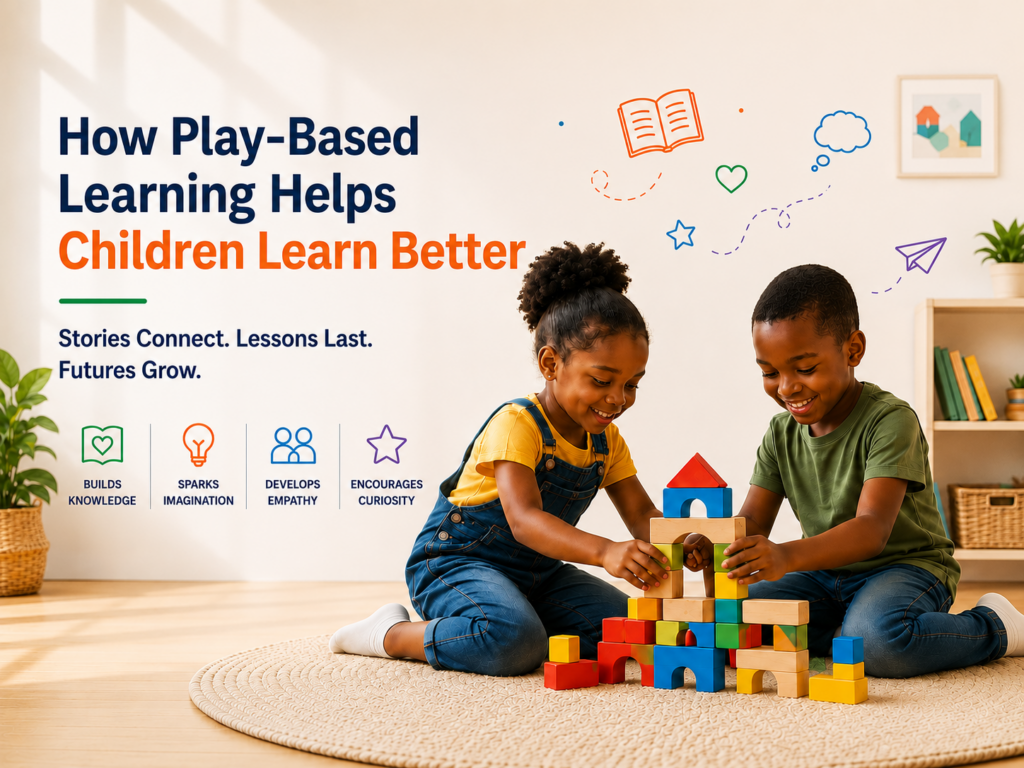
Whether they’re building with blocks, pretending to run a shop or playing educational games, every playful moment can become a valuable learning experience.
🧠 Does Play Really Help Children Learn?
Play is much more than just fun! It is a natural way for children to learn.
When children play, they explore new ideas, ask questions, solve problems and learn from experience. Because they enjoy what they’re doing, they stay engaged and remember lessons more easily.
Play also gives children a safe space to make mistakes, try again and build confidence. That’s why educators around the world recognize play as an important part of healthy childhood development.
🎯 What Is Play-Based Learning?
Play-based learning combines purposeful teaching with enjoyable activities.
Instead of simply memorising facts, children learn by:
- Exploring new ideas
- Creating and building
- Asking questions
- Solving problems
- Working with others
- Experimenting solutions
Play-based learning doesn’t actually replace classroom teaching. However, it helps children apply what they learn in meaningful and practical ways.
🌟 Benefits of Play-Based Learning
1. Play sparks curiosity
Curious children become lifelong learners. Play encourages children to ask questions, explore new ideas and discover how things work.
2. Developing problem solving skills
Whether solving a puzzle, building a tower or inventing a game, children learn to think critically, make decisions and adapt when things don’t go as planned.
3. Play Encourages Creativity
Drawing, storytelling, music, dance and imaginative games help children express themselves and develop original ideas.
Creative play also builds confidence and communication skills.
4. Play Builds Social Skills
Many play activities teach children to:
- Collaborate with others
- Listen actively
- Share ideas respectfully
- Present thoughts clearly
- Resolve conflict
These skills help children succeed in school and everyday life.
5. Play supports language development
Talking, storytelling and pretend play naturally help children build vocabulary, improve communication and become better listeners.
6. Play builds confidence
Every completed puzzle, finished drawing or successful challenge gives children a sense of achievement.
These small wins encourages kids to keep learning and trying new things.
7. Play makes learning memorable
Children often remember experiences better than facts alone.
Active, hands-on learning creates stronger memories than simply reading or listening. That’s why games, storytelling and creative activities are such effective teaching tools
📱 Play and Educational Screen Time
Kids today are mostly digital natives as they live in a predominantly tech-driven society with heavy use of electronic devices including; phones, tabs, laptops, gaming consoles, etc. Screen time on this devices can however, support learning effectively when structured to be interactive and balanced.
For example, children can:
- Watch and engage with educational content
- Answer questions around such content
- Recreate an activity or experiment
- Retell stories in their own words
This turns screen time into active learning instead of passive entertainment.
🤝 Join the Branama TV Community
We’re just getting started—and we’d love you to join us.
Explore our growing library of educational videos, games and quizzes designed for children across Nigeria, Africa and the African diaspora.
Whether you’re a parent, teacher, caregiver or young learner, there’s always something new to discover with Branama TV.
You can also watch us on our YouTube channel, visit our website, or tune in on cable TV; Free TV and Startimes Channel 135.
📌 Key Takeaways
- Play is one of the most effective ways children learn.
- Play builds curiosity, creativity, communication and confidence.
- Everyday activities can become valuable learning opportunities.
- Educational screen time works best when children actively participate.
- Branama TV uses play-based learning to make education engaging, meaningful and fun.
❓Frequently Asked Questions
Do children really learn better through play?
Play keeps children actively involved in learning. It strengthens curiosity, creativity, problem-solving and communication while making lessons more enjoyable and memorable.
Is play-based learning suited for younger kids?
No. Children of all ages benefit from meaningful play. Older children continue to develop leadership, teamwork, critical thinking and communication skills through interactive activities.
Can games improve learning?
Yes. Well-designed educational games help children practice new skills, solve problems and apply what they’ve learned in fun and engaging ways
Does play replace classroom learning?
No. Play complements formal education by helping children understand, practice and apply classroom lessons through real-life experiences.
How much play should children have?
Children should enjoy opportunities for active, creative and imaginative play every day. The right amount depends on their age, but regular play is an important part of healthy learning and development.
BRANAMA TV
